Approval of cookies
By clicking "Accept" , you agree that we store cookies on your device to analyze your website visit. See our privacy statement for more information.

A capital raise doesn't start with a document, but with outreach to potential investors. An investor will want answers to some very basic questions – and the answers often determine whether you move on to a term sheet.
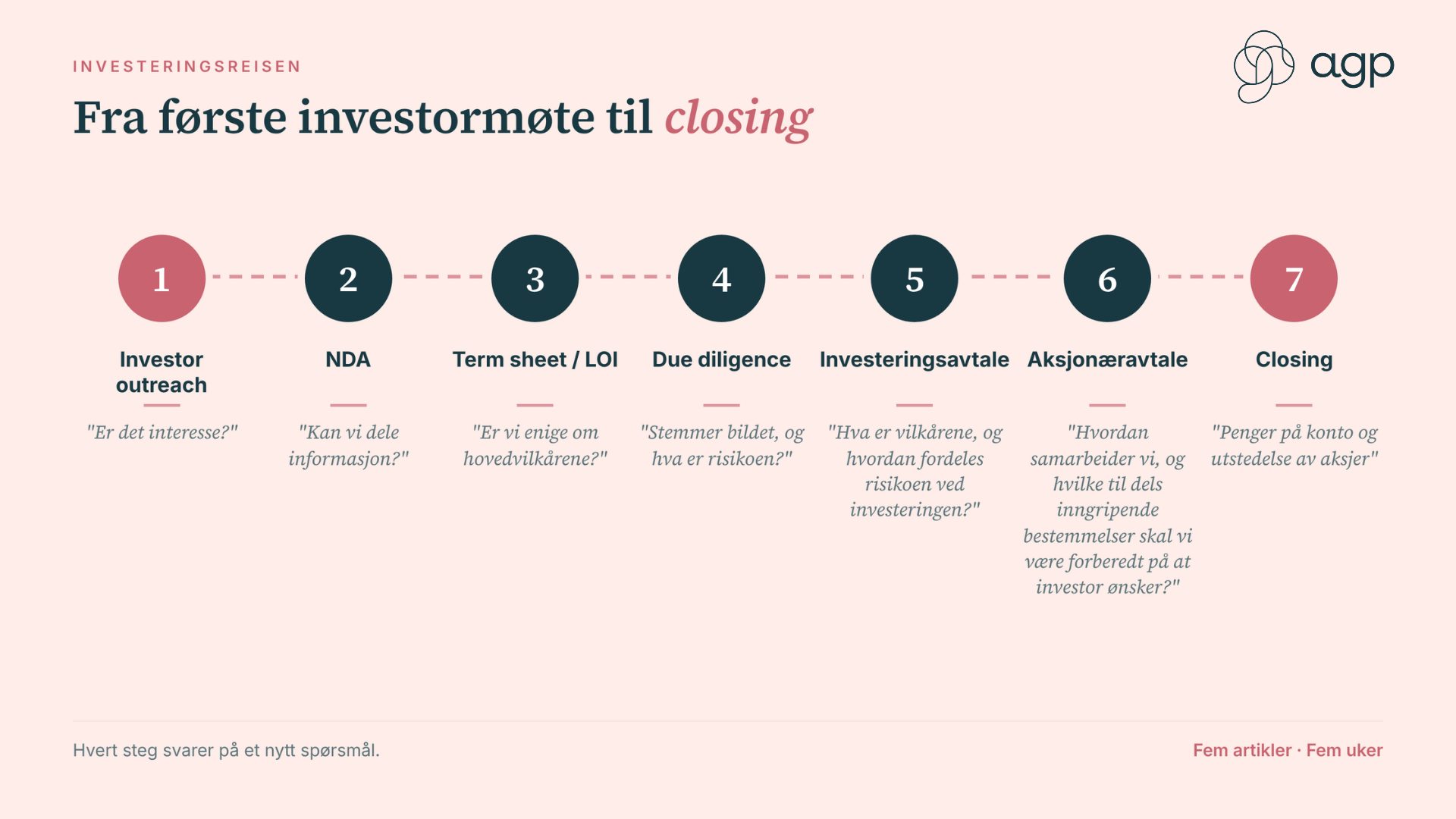
Most investment rounds follow the same pattern: investor outreach, NDA, term sheet, due diligence, investment agreement and shareholder agreement, and finally closing. Each step answers a new question, from "is this interesting?" to "the money has been paid and the shares have been issued." In this series, we'll go through the steps one by one.
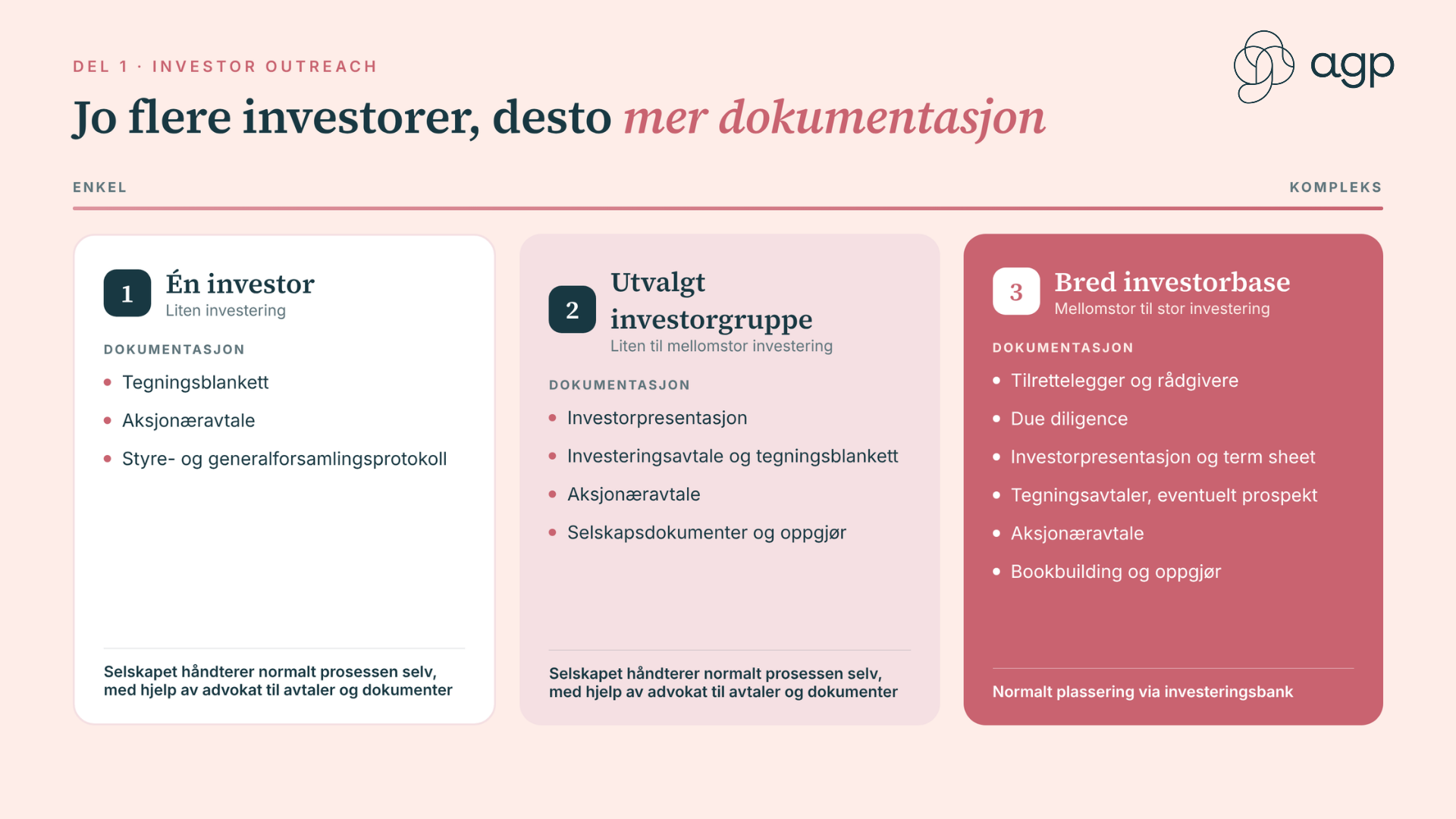
How extensive the process will be depends primarily on how many potential investors you want to involve and how much capital you need. Below we describe three types of cases.
• One investor: Typically a smaller investment. The documentation can be as simple as a subscription form, shareholder agreement, board minutes and general meeting minutes. The company can usually handle the process itself, with the help of a lawyer for the shareholder agreement and company documentation.
• Selected investor group: Typically a few to several investors and a small to medium-sized investment. In addition to the documentation mentioned above, an investor presentation and investment agreement are often prepared.
• Broad investor base: Typically many investors and greater capital needs. The company will consider engaging a financial facilitator to assist with marketing and placement of the issue. The process may include due diligence, as well as additional documentation in the form of, among other things, term sheet, C&I, bring-down, lock-up (binding period), etc. It must also be considered whether the offering triggers a prospectus obligation.
1. Pre-money valuation. What is the value of the company before the new capital? Together with the number of shares (preferably fully diluted), this gives the subscription price.
2. Enterprise value or equity value? Is the pre-money valuation based on enterprise value or equity value? Enterprise value is the business value on a cash and debt-free basis, often calculated as, for example, EBITDA or ARR multiplied by a multiple. Equity value is the value of the shares after deducting net interest-bearing debt and adjusting for deviations from normalized working capital. The difference can be a lot per share, so it must be clear what the number means.
3. Fully diluted number of shares. All shares that exist or may arise, including options, warrants and convertible loans. Also remember SAFEs and SLIPs. The investor wants to know how much ownership the investment actually provides.
4. Lead investor. A lead investor takes a leading role in negotiations on terms and documentation and in due diligence. Many investors want a lead investor in place before they get involved themselves. Finding a lead investor who will take on this role, with the costs and resource use it entails, is therefore often an important first step for the company.
5. Cap table. The composition of the owners has an impact on, among other things, cooperation, governance, future access to capital and possible conflicts of interest. Are there already owners who, with their network, can open doors to new markets, or who have access to capital-intensive environments in, for example, the USA?
6. The shareholder agreement. Investors want to know what rights existing shareholders have, and will often demand changes or a new agreement. Has a lock-up and vesting on the founders' shares already been agreed? Are there regulations on pre-emptive rights and drag-along obligations?
The answers can have a major impact on whether an investor wants to proceed with negotiations on a term sheet. They also affect how attractive the investment is. They also show the company's commercial potential, and they give an indication of how mature and prepared the company and management are. Good, well-thought-out answers build trust and show control.
• Have an updated, fully diluted cap table ready before the first investor meeting.
• Clarify whether the valuation is stated as enterprise value or equity value, and use the term consistently.
• Have a good shareholders' agreement in place, and read through the shareholders' agreement and articles of association before the investor does. Whatever you discover first, you can handle on your own terms.
• Clarify early on what type of capital round you want. This will control the timeline, costs and documentation.
Next article: NDA and term sheet.
The article provides general information and is not legal advice.
AGP assists companies, entrepreneurs and investors throughout the entire process. Contact us for a no-obligation chat and tips and advice.


